
مدونة
الكتالوج
أحدث مدونة
A universal strength tester performs tensile, or pull, testing only. A universal testing machine runs tensile, compression, and flexural tests in one configurable frame. That difference matters at purchase time. Buyers who choose a universal strength tester pay for focused capability. Buyers who choose a UTM gain flexibility for future test methods. The wrong match cuts both ways: excess capability adds cost, and missing capability adds outsourced testing or a second machine. This comparison defines both instruments and weighs applications, load capacity, and cost. UTS International supplies both options and helps buyers match equipment to real testing needs.
A universal strength tester only pulls samples apart. A universal testing machine pulls, compresses, and bends samples.
Choose a universal strength tester for one test method at high volume. Choose a UTM for mixed methods or future flexibility.
A universal strength tester costs less because it does one job. A UTM costs more because it does many jobs.
Match the machine's load capacity to your sample forces. Too much capacity wastes money. Too little capacity gives unreliable data.
Some facilities need both machines. A dedicated tester handles routine checks. A UTM handles lab development and complex tests.
A universal strength tester is a tensile testing instrument at its core. The machine grips a specimen at both ends, applies a controlled pulling force, and records how the material responds until it breaks or reaches a set elongation. This single-purpose design keeps operation straightforward. An operator loads the sample, selects a test speed, and starts the run. The software logs force and extension data and reports tensile strength, elongation, and related values.
The focused build helps users understand how a material behaves when pulled apart. A quality engineer can see where a plastic strip yields, how much a rubber sample stretches, and at what force a metal wire snaps. A compact Single Column Tensile Strength Tester suits smaller specimens and lighter loads, which makes it a common sight on a bench in a quality lab. An Electronic Tensile Strength Machine adds digital force measurement and automated data capture, so results are recorded consistently from one shift to the next.
Quality control labs, production lines, and facilities with high-volume, single-test needs form the core user base of a universal strength tester. A wire manufacturer may pull samples from every production batch. A packaging plant may check seal strength on film. These operations run the same test many times a day, and they value speed and repeatability over test variety.
The wider testing world covers tensile, compression, flexure, peel, tear, hardness, and torsion methods across metals, plastics, rubber, composites, and ceramics, with standards such as ASTM E8, ISO 6892-1/2, ASTM D638, and ISO 527 guiding the procedures. Aerospace, automotive, construction, and materials science labs draw on this breadth. A tensile-focused instrument serves the subset of that work that involves pulling samples apart. Its focused design generally makes it more affordable than a multi-test machine, which matters for buyers who will never run a compression or flexure test.
A universal testing machine is a configurable system that measures mechanical properties under controlled conditions. The frame holds a moving crosshead, a load cell, and interchangeable grips or fixtures. An operator selects a test method, and the machine applies force at a set rate while the software records the response.
The key advantage is test variety. A UTM performs tension, compression, and flexural tests on the same frame, unlike a tensile-only tester. A lab can pull a plastic dog-bone specimen in the morning, crush a foam block after lunch, and bend a composite beam before the shift ends. Each method uses its own fixture, and the changeover takes minutes rather than a new machine purchase. This flexibility serves labs that face changing standards or mixed material portfolios.
Buyers can choose from a wide range of load capacities and frame designs. Low-force benchtop models handle delicate films and small components. High-capacity frames test structural metals and heavy assemblies. Electromechanical UTMs are often quieter, take up less space, are easier to move, use less power, and need less maintenance than hydraulic alternatives, which makes them a practical fit for most quality labs.
Frame architecture follows the same logic. A Dual Column Universal Testing Machine supports larger specimens and higher forces with a stable twin-column structure, so the frame stays rigid during demanding pulls and compression runs. The load cell, grips, and software package all scale with the frame, and buyers can add fixtures later as test methods grow. This modular path lets a lab start with the tests it runs today and expand into new methods without replacing the core system.
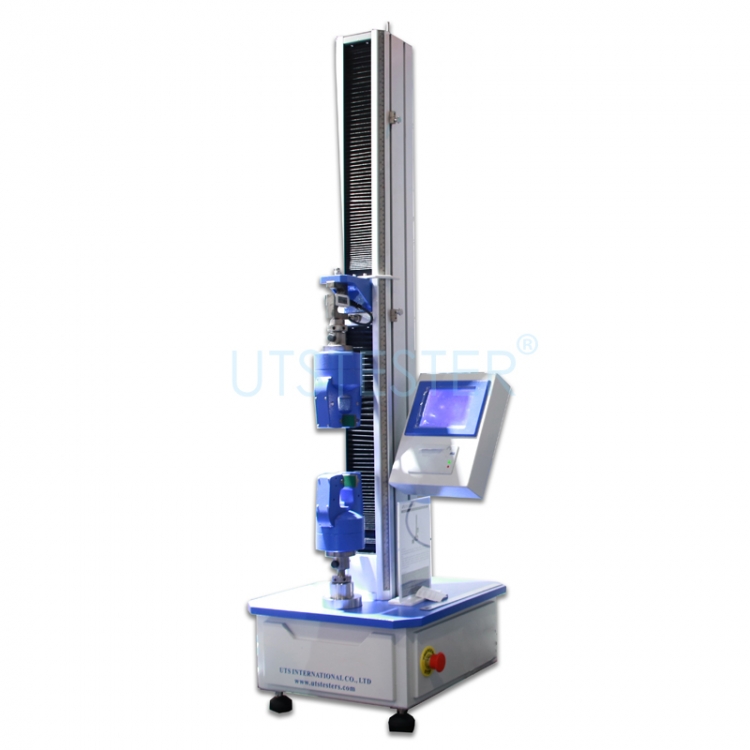
Tensile testing mounts a specimen in the grips and pulls it at a controlled rate until fracture. The instrument records force and displacement, then converts both into engineering stress and strain. The resulting stress-strain curve yields the core strength data that material characterization depends on: ultimate tensile strength, yield point, elongation at break, modulus, and toughness as the area under the curve.
These values carry real decision weight. A study of carburized specimens illustrates the point. The C1 sample reached a yield strength of 1318.3 MPa, a 68.7% enhancement over the non-carburized baseline, and a tensile strength of 1478.6 MPa, a 30.5% improvement. Its reduction in area was 2.1%. The same tests validated a composite strength prediction model with errors below 7%, and the minimum error was 1.2%. Tensile data therefore does more than rank materials; it confirms whether a model or process change actually delivers.
The fracture pattern adds another layer. Carburizing creates a hard, brittle surface over a tougher core. Under load, cracks start at surface defects and propagate inward, where the core's plastic deformation resists growth. The mixed fracture mode reveals how surface and core behave relative to each other.
Test conditions must suit the material. Speed, grip type, gauge length, and temperature all follow standardized procedures, and the wrong standard produces data no one can compare. Metals, plastics, composites, and flexible films each have their own accepted methods.
|
Material Class |
Recommended Standard(s) |
Typical Specimen Shape |
|---|---|---|
|
Metals |
ASTM E8/E8M; ISO 6892-1/2; JIS Z 2241 |
Dog-bone (round or flat) |
|
Plastics |
ASTM D638; ISO 527 |
Dog-bone or flat |
|
Composites |
ASTM D3039/D3039M |
Flat |
|
Thin sheets / flexible materials |
ASTM D882; ASTM D828; ISO 37 |
Flat |
|
Metal rods/bars |
ASTM E8/E8M |
Round |
Matching the standard to the material protects both the specimen and the result. A flexible film tested with metal grips may slip or tear at the jaw. A composite tested at the wrong rate may report strength that no design engineer can use. Buyers should confirm that their chosen instrument supports the fixtures and speed ranges their standards require.
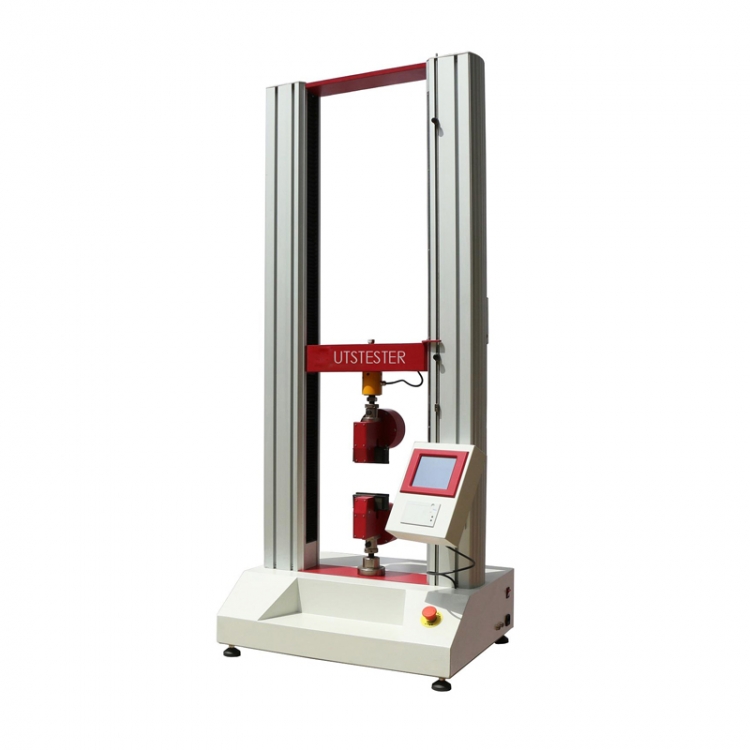
Application range and testing volume drive the choice between the two instruments. A facility that runs one test method at high volume fits a universal strength tester well. The operator repeats the same pull test hundreds of times per week, and the focused design keeps throughput steady. A lab that faces mixed methods, changing standards, or a growing material portfolio fits a UTM better. The same frame handles tension, compression, and flexure as demand shifts.
Some operations need both. A production line may run routine tensile checks on a dedicated tester while the central lab keeps a UTM for development work and failure analysis. This split keeps high-volume testing off the more versatile machine and protects lab capacity for complex projects. Buyers should map their test methods against expected volume before deciding. A short list of current methods, plus a realistic forecast of future ones, usually settles the question.
|
Buyer Profile |
Best Fit |
|---|---|
|
One method, high volume, routine QC |
Universal strength tester |
|
Mixed methods, changing standards, R&D |
UTM |
|
Routine line checks plus lab development |
Both instruments |
A tensile tester is generally more affordable due to its focused design and limited scope. The buyer pays for one test type, one fixture family, and software tuned to tensile work. A UTM's price reflects force capacity, measurement capability, and software depth. Higher load frames, interchangeable fixtures, and multi-method software all add cost. Buyers should treat price as a match to need, not a ranking of quality.
Accuracy and load capacity follow the same logic. Each instrument class covers a range of capacities, and the right pick depends on specimen forces and required resolution. A tester sized for light film loads delivers reliable data within its range. A UTM with a matched load cell does the same across a broader test menu. Neither option is inherently more accurate; each fits best where its capacity and configuration align with the work. A buyer who overspecifies capacity pays for headroom that never gets used. A buyer who underspecifies risks data outside the instrument's reliable range.
UTS International can supply both options and help match equipment to needs. The company reviews a buyer's methods, volumes, and force ranges, then recommends the configuration that fits. That guidance keeps the purchase tied to real testing requirements rather than a generic specification sheet.
A universal strength tester pulls specimens apart; a universal testing machine pulls, compresses, and bends them. Buyers can map their needs to three factors. Application range decides first: one method points to a tester, mixed methods point to a UTM. Required accuracy and load capacity come next, sized to actual specimen forces. Testing volume settles the rest, since high-volume routine work suits a dedicated instrument. UTS International helps buyers weigh both options against these requirements. A clear method list today, plus room to grow tomorrow, keeps the purchase sound for years.
No. A universal strength tester performs tensile testing only. Compression and flexural methods require a universal testing machine with the appropriate fixtures. A buyer who needs those methods should choose a UTM from the start.
A compact benchtop model often fits well. The Single Column Tensile Strength Tester handles smaller specimens and lighter loads on a modest footprint. A lab that runs routine pull tests on film, wire, or small components can work efficiently within that range.
Many models do. The Electronic Tensile Strength Machine adds digital force measurement and automated data capture. Results stay consistent from one shift to the next, and operators spend less time on manual logging.
Higher forces and larger specimens call for a sturdier structure. The Dual Column Universal Testing Machine keeps the frame rigid during demanding pulls and compression runs. Labs with mixed methods and heavier samples gain stability and room to add fixtures later.
Yes. A production line can run routine tensile checks on a dedicated tester while the central lab keeps a UTM for development work and failure analysis. This split protects lab capacity and keeps high-volume testing moving.

Room 312, Block D, Jiayuan Garden, No.2 Zhongfa Road, Zhangzhou City, Fujian Province, China

+86 152 6060 5085

+86 596 7686689


حقوق الطبع والنشر © UTS International Co., Ltd


 +86 152 6060 5085

 English
 русский
 español
 português
 العربية
 Polski

 hello@utstesters.com
 hello@utstesters.com
 +86 152 6060 5085
 +8615260605085
