
مدونة
الكتالوج
The quality of footwear materials directly determines the comfort, durability, and safety of shoes. As the two core categories in the footwear materials market, leather and synthetic materials exhibit significant differences in testing methods due to their inherent material properties and processing techniques. For footwear manufacturers, testing institutions, and relevant practitioners, understanding these testing differences is a critical prerequisite for ensuring product quality and compliant production.
I. Material Differences Between Leather and Synthetic Materials
Leather, a natural animal fiber material, offers core advantages in breathability, moisture absorption, flexibility, and natural grain patterns. Testing focuses on “preservation of natural properties,” “impact of processing techniques on material characteristics,” and “natural wear during use,” while also addressing chemical safety and environmental compliance—given that tanning and finishing processes may leave residual harmful chemicals.
Synthetic materials (primarily PU, PVC, microfiber, TPU, etc.) are artificially synthesized polymers characterized by abrasion resistance, waterproofing, low cost, and diverse styles. Testing focuses on “stability of synthetic properties,” “durability compliance,” and “chemical composition safety.” The core objective is to verify long-term suitability for footwear use while mitigating safety risks from additives introduced during synthesis.
Simply put, leather testing “respects natural variations while controlling process impacts,” while synthetic material testing “pursues standardized consistency to ensure stable durability.” This core logic underlies all testing protocols.
II. Differences in Test Items
Whether for leather or synthetic materials, footwear material testing revolves around three core dimensions: physical and mechanical properties, chemical safety performance, and material identification. However, the specific test contents, emphasis, and judgment criteria differ significantly. Below is a comparison of the most commonly used key test items.
1. Tensile and Tear Strength Testing
Leather tensile and tear strength tests primarily verify the resilience of natural collagen fibers and inter-fiber bonding strength. Leather's natural fibrous network structure features uneven fiber distribution, necessitating sample collection from different areas (e.g., grain side, flesh side) and allowing for performance variability. Tests are conducted using universal testing machines per GB/T 4689.5 and ISO 3376 standards. Upper leather must meet ≥15 N/mm² tensile strength and ≥30 N/mm² tear strength. Close attention is paid to fiber fracture patterns during stretching to determine if insufficient tanning causes brittle fiber breakage.
For synthetic materials, tensile and tear strength tests primarily validate polymerization degree and intermolecular bonding strength. Synthetic fibers exhibit regular arrangement and uniform structure, with no regional variation in testing samples, requiring stable performance values. Taking PU leather as an example, testing follows GB/T 1037 standards with greater emphasis on elongation at break (typically ≥300%). This ensures synthetic materials withstand footwear bending and deformation without cracking due to insufficient tensile properties. TPU sole tensile strength testing must comply with T/GDFMA standards, requiring outsole tensile strength ≥5.0 MPa.
2. Flexing Resistance Testing
Footwear materials undergo repeated bending during wear, and flexing resistance directly determines susceptibility to cracking or breaking. The core difference in testing lies in the “simulated scenarios” and “evaluation criteria.”
Leather flexing tests simulate the “fatigue characteristics” of natural fibers. Using a leather flexing tester, tests are conducted per GB/T 4689.9 or ISO 5402 standards. Testing conditions are relatively mild (typically room temperature with controlled humidity), requiring ≥100,000 flex cycles without cracking. Key observations include whether the grain surface develops pilling or cracks, and whether the flesh side separates—particularly for shaved leather and coated leather, where attention must be paid to the adhesion between the coating and the leather substrate to prevent coating peeling during flexing. For specially treated leathers, additional testing is required to assess color difference changes after bending, ensuring appearance stability.
Synthetic materials' fold resistance testing must simulate “stability under high-frequency deformation.” Conducted using footwear material fold resistance testers per GB/T 3903.1 and ISO 5402 standards, certain synthetics (e.g., PVC leather) require low-temperature testing (simulating winter wear scenarios). Results must show no cracks, breaks, or substrate delamination after bending. Taking PU synthetic leather as an example, post-test evaluation must show no substrate cracking and no large-area coating peeling. For polyurethane composite soles, flexing must yield no more than 3 new cracks, each under 5.0 mm in length, with no paint cracking or component delamination.
3. Abrasion Resistance Testing
Leather abrasion testing focuses on “grain abrasion resistance” since leather's aesthetic appeal relies primarily on its grain (natural texture). Tests are conducted using Taber abrasion testers and Martindale abrasion testers in accordance with GB/T 3903.16 and ISO 17704 standards. Simulating upper friction scenarios, the test requires ≥5000 revolutions without noticeable wear or grain loss, with slight pilling permitted (considered normal wear for natural fibers). For full-grain leather, post-testing inspection must confirm intact grain pores to maintain breathability.
For synthetic materials, the focus is on “overall abrasion resistance” since synthetic materials lack a natural grain. Abrasion performance is primarily determined by the surface coating and substrate. The same testing equipment is used, but with higher load and more revolutions (e.g., synthetic leather for athletic shoes requires ≥10,000 revolutions without significant wear). Taking PVC leather as an example: after abrasion testing, the substrate must not be exposed, and the surface coating must show no large-area peeling. For solid synthetic outsoles, the relative volume loss must be ≤300 mm³; for microporous outsoles, the relative mass loss must be ≤200 mg.
4. Thickness and Density Testing
Leather thickness testing must account for natural variations. A thickness gauge with 0.01mm precision is used, following GB/T 4689.4 and ISO 2589 standards. A ±0.2mm thickness tolerance is permitted within the same batch. Focus is placed on how thickness uniformity affects footwear fit—particularly for upper leather, where uneven thickness can cause unevenness after shoe molding.
Thickness testing for synthetic materials demands extremely high precision, with no significant deviation permitted. Tolerances must be controlled within ±0.1mm. This is because synthetic materials used in footwear must precisely align with other components (such as soles and insoles), and thickness variations can compromise the overall structural integrity of the footwear.
III. Differences in Testing Standards and Instruments
(1) Testing Standards: Categorized Specifications with Distinct Focuses
Testing standards for leather and synthetic materials are divided into domestic standards (GB, QB) and international standards (ISO, ASTM). However, each standard system has its own emphasis and provides explicit, dedicated standards for different materials to avoid cross-confusion.
Leather Testing Standards: Domestically, GB/T 4689 series (physical properties), GB/T 19941, GB/T 22807 series (chemical properties). Internationally, ISO 3376, ISO 3377, and ISO 17075 series are primary, while compliance with OEKO-TEX® LEATHER ecological labeling requirements is also mandated. These standards primarily regulate testing methods and judgment criteria for natural materials, allowing for inherent natural variations.
Synthetic Material Testing Standards:
Domestic standards primarily include GB/T 1037 (PU leather), GB/T 13542.2 (PVC leather), and T/GDFMA standards (synthetic soles). Internationally, ISO 14253 and ISO 15985 series are predominant. These standards emphasize uniformity and stability testing for synthetic materials, requiring minimal performance variation while complying with OEKO-TEX® 100 standards to ensure chemical safety.
(2) Testing Instruments: Material-Specific Selection for Accuracy
Instrument selection must align with material characteristics. Leather testing equipment emphasizes “adapting to natural variations,” while synthetic material testing focuses on “precision error control.” Core instrument differences are as follows:
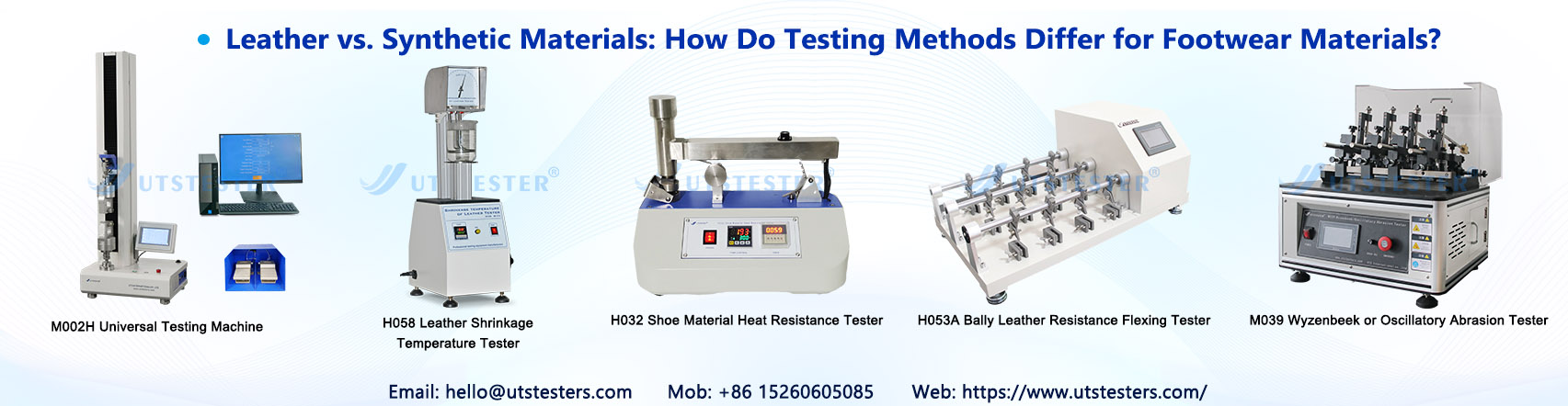
• Common Instruments: Universal Testing Machine (UTM) for tensile and tear strength; Taber/Martindale Abrasion Tester for wear resistance; Flexure Tester for fold endurance; Thickness Gauge for dimension measurement; ICP-MS for heavy metal analysis. However, parameter settings differ: - Leather testing equipment offers broader adjustment ranges to accommodate samples from various locations and thicknesses. Synthetic material testing instruments feature more precise parameters and stricter error control.
• Leather-specific instruments: Leather Crush Tester (measures upper leather crush resistance per ISO 3379, QB/T 2711 standards), Micro-infrared Spectrometer, PCR Amplifier (molecular biology identification), Leather-specific Flexing Tester (simulates natural fiber fatigue characteristics).
• Synthetic Material-Specific Instruments: Thermogravimetric Analyzer (TGA, material identification), Pyrolysis-GC/MS Coupled Instrument (precise identification of synthetic material types), Low-Temperature Flexing Tester (simulates low-temperature flexing performance), Density Meter (accurate measurement of synthetic sole density).
Additionally, addressing industry pain points, portable testing instruments have emerged. For instance, portable NIR (near-infrared) devices can distinguish genuine leather from synthetic materials on-site within 5 seconds with >95% accuracy. AI image recognition technology enables rapid material identification by capturing microtexture patterns via smartphone macro photography and comparing them against databases, significantly boosting testing efficiency.
IV. Conclusion
The differences in testing methods for leather and synthetic footwear materials fundamentally stem from the inherent properties of “natural materials” versus “artificial synthetic materials.” Leather testing respects natural variations, focusing on controlling the impact of processing techniques on material performance and chemical safety while balancing durability with natural attributes. Synthetic material testing pursues standardized consistency, prioritizing material stability and durability while strictly managing safety risks associated with synthetic additives.
Understanding these testing distinctions enables footwear manufacturers to optimize raw material selection and production process control, preventing product non-compliance due to inappropriate testing methods. For testing institutions, it allows precise selection of test items, instruments, and standards, enhancing testing efficiency and accuracy. For the textile testing instrument industry, this enables targeted development of specialized testing equipment for diverse materials—such as portable identification instruments and high-efficiency chemical analyzers—to meet the sector's varied testing demands. This drives the footwear materials testing industry toward greater efficiency, precision, and environmental sustainability.
Email: hello@utstesters.com
Direct: + 86 152 6060 5085
Tel: +86-596-7686689
Web: www.utstesters.com

Room 312, Block D, Jiayuan Garden, No.2 Zhongfa Road, Zhangzhou City, Fujian Province, China

+86 152 6060 5085

+86 596 7686689


حقوق الطبع والنشر © UTS International Co., Ltd


 +86 152 6060 5085

 English
 русский
 español
 português
 العربية
 Polski

 hello@utstesters.com
 hello@utstesters.com
 +86 152 6060 5085
 +8615260605085
